Ag and Food Systems
Project Description
The Ag and Food Systems project team seeks to strengthen Maui County’s food systems by investing in local producers and regional infrastructure to improve food security, drive economic diversification, and build long-term community resilience. The initiative focuses on supporting small and mid-sized producers and expanding value-added production pathways that foster local ownership and profitability.
Maui County imports an estimated 85-90% of its food, making the region highly vulnerable to supply chain disruptions, rising costs, and climate-related shocks. Despite this, small and mid-sized producers face persistent barriers to scaling production and accessing markets- limiting their ability to meet local demand and compete with imports.
In close partnership with farmers, ranchers, fishers, and food businesses, the initiative addresses critical gaps in production, distribution, and market coordination. The initiative will prioritize sustainable land stewardship, culturally grounded agricultural practices, and equitable access to local markets- especially for Native Hawaiian communities and small-scale operators. This work directly advances the Maui County Food & Nutrition Security Plan by building food supply chains that are both community-rooted and economically viable.
To address structural barriers, the Taskforce will lead targeted systems-level interventions- identifying and implementing solutions to inter- and intra-island shipping challenges; expanding institutional market access through digital planning tools and coordinated procurement; supporting the development of shared infrastructure such as cold storage and protein processing facilities; and deploying direct investments- such as protein subsidies and capacity-building grants- to stabilize and scale local operations.
These efforts build on proven programs and trusted partnerships already active in Maui County- from mobile markets and food-as-medicine initiatives to regenerative ranching and over a decade of food systems organizing. Led by a coalition of local producers, community-based organizations, and policy advocates this initiative advances a shared vision: a resilient, locally controlled food economy rooted in community knowledge, cultural integrity, and long-term sustainability.
Team members
Eric Arquero, Executive Director, Kaibigan Ng Lahaina
Yayoi Hara, Project Outreach & Network Specialist, Maui Nui Botanical Gardens
Jennifer Karaca, Founding Executive Director, Common Ground Collective
Jackie Keefe, Fellow, Treecovery
Courtney Lazo, Lahaina Strong
Lauren Nelson, Food Access Coordinator, Maui County Department of Agriculture (MDOA)
Steve Phillips, Co-Founder, Local Harvest
Georgia Pinsky, Maui Farmers Support Network
Blake Ramelb, BKR Vlogs
Jeannine Rossa, MDOA
Alignment with West Maui Community Plan (WMCP)
This project directly aligns with several Maui County priorities, including the Maui Recovery Framework, the County’s Climate Action and Resiliency Plan, and the Countyʻs Food Security Action Plan. It supports the goals of economic diversification, environmental sustainability, disaster resilience, and increased self-sufficiency.
Objectives
Strengthen coordination between producers, buyers, and institutions through targeted engagement, demand planning, and aggregation strategy development
Support increased local food production by investing in technical assistance, microgrants, and infrastructure that align with market demand
Reduce reliance on imported food by building systems that increase the viability and competitiveness of local proteins and produce
Develop and work to implement policy and subsidy models that remove regulatory and cost barriers for small and mid-scale producers
Build digital tools and data systems to support production planning and institutional procurement alignment
Generate evidence and momentum for long-term investments in processing, cold storage, and distribution infrastructure
Integrate local food systems planning into County and State economic development and health equity efforts
Tasks & Timelines
Phase 1: Groundwork & Policy Development (Current)
This phase lays the foundation for long-term systems change by leveraging the team’s existing networks, identifying systemic barriers, and shaping a unified policy agenda.
Convene producers, ranchers, and food businesses for targeted input sessions
Identify critical gaps in infrastructure, regulatory barriers, and market access and planning
Collect qualitative and quantitative data to inform 3–5 core policy priorities (e.g., inter-island shipping, protein subsidies, health and safety regulations for processing and sales)
Collaborate with County and State policymakers to develop and share draft policy proposals and possible subsidy designs to incentivize local protein
Initiate development of a digital planning tool to help producers align production with institutional demand for local proteins and produce
Facilitate buyer coordination conversations and conduct demand planning to shape future aggregation strategies
Phase 2: Direct Investment & Pilot Programs (Future)
Building on the groundwork of Phase 1, this phase will test targeted strategies and deliver early-stage investments to strengthen local production and prepare for long-term systems transformation.
Potential activities include:
Deploy microgrants and unrestricted funding to producers and ranchers to scale production in alignment with new market pathways
Explore pilot models for producer-buyer aggregation and fair pricing coordination
Finalize shared infrastructure designs and launch pilot sites (e.g., cold storage, protein processing)
Refine and advance policy proposals developed in Phase 1 by working with County and State partners to prepare implementation frameworks, address regulatory constraints, and identify pilot locations or programs tied to proposed subsidy models
Phase 3: Infrastructure Buildout & Market Integration (Future)
Informed by pilot outcomes and adopted policies, this phase would scale successful strategies to embed local food into regional systems and ensure long-term sustainability.
Potential activities include:
Complete infrastructure investments and launching operations (cold storage, processing hubs)
Coordinate with County/State and institutional buyers to secure procurement commitments
Implement and monitor adopted policy changes, including tracking subsidy utilization, resolving compliance challenges, and supporting regulatory adaptation where needed
Identify long-term mechanisms to sustain effective policies and funding structures (e.g., recurring County/State appropriations, dedicated procurement pathways, or permanent administrative support for local producer access)
Project Budget
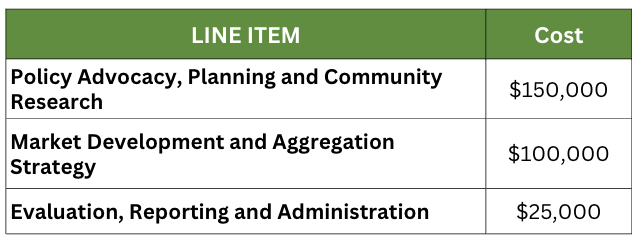
Total: $275,000